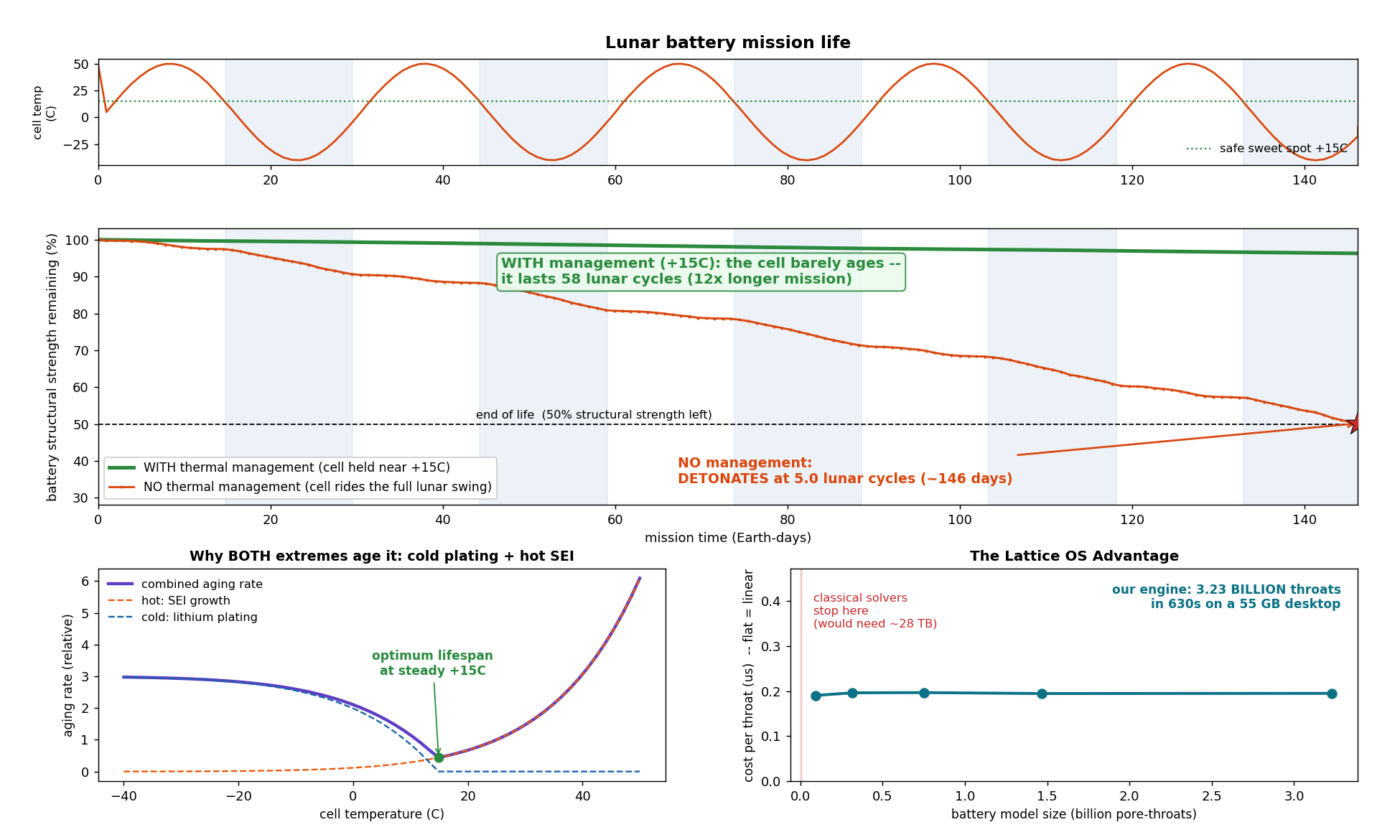
A lithium-ion cell ages fastest at both temperature extremes, and slowest in a narrow band between them. In the cold, charge cannot insert fast enough and plates as metallic lithium on the rate-limiting pores; in the heat, the cell's degradation layer grows and clogs the same pores. The two mechanisms attack the same bottlenecks, so the aging rate is U-shaped — a safe minimum with a steep wall on either side. The lunar duty cycle sweeps the cell across the whole U twice a month.
| Cell temperature | Relative aging rate |
|---|---|
| −40°C (lunar night) — lithium plating | ~7× |
| +15°C — the safe minimum | 1× |
| +50°C (lunar noon) — degradation growth | ~14× |
relative to the +15°C minimum; illustrative for this cell. The position of the safe minimum and the steepness of each wall are properties of the specific microstructure.
Over each lunar cycle the cell's structural strength falls in a poisoning staircase: a steep step at each noon (heat) and each night (cold), a plateau through the mild transitions. Left unmanaged, it does not coast gently to half capacity. Under constant-current operation — how a fast charger or a habitat bus actually drives a cell — the fixed current is forced through fewer and fewer surviving pathways as the cell ages, so the local heating climbs as the square of that constriction until the internal hot-spot crosses the ignition threshold. End of life is not a whimper; it is a thermal runaway, and it arrives at the same moment the structure gives out.
| Regime | Mission life |
|---|---|
| No thermal management — raw lunar swing | ~5 lunar cycles, ends in runaway |
| Held at the +15°C sweet spot | ~58 lunar cycles |
| Always hot (+50°C) | ~5.5 cycles |
| Always cold (−40°C) | ~3 cycles |
Always-cold dies sooner than always-hot despite the lower aging rate: cold damage is targeted — it severs the load-bearing pathways first. Illustrative figures for this cell.
The whole mission turns on one number: the 12× separating the unmanaged cell (~5 cycles) from the managed one (~58 cycles). That is the value of holding the cell near +15°C — and JOULE prices it from the microstructure, before the pack is built, so a designer can trade heater mass and insulation against mission life with an exact figure instead of a rule of thumb. The same engine returns the safe cold fast-charge limit, the self-ignition charge rate, and the densest electrode that survives both.
A dramatic mission-life claim is only worth as much as the engine beneath it. JOULE's transport observable is the classical tortuosity factor — the same quantity the open-source reference (TauFactor, Imperial College) computes from tomography. On a public 256³ NMC electrode micro-CT, JOULE returns it to within 0.121% of TauFactor, machine-precise on exact analytical geometries, and 3.47× faster — a comparison anyone can reproduce, on public data, against a public tool, on the same electrode it certifies a 3.23-billion-element pack from. The aging and ignition thresholds layered on top are calibrated to reference data; the transport floor they stand on is externally checkable.